
Sound healing is the use of intentional sound — singing bowls, gongs, chimes and the voice — to guide the body and mind into a calmer, more restorative state. If you have ever felt your shoulders drop when a low, resonant tone fills a room, you have already felt the beginning of it.
This guide explains what sound healing is, what actually happens in your body during a session, what the research does and does not say, and how to get started.
What is a sound bath?
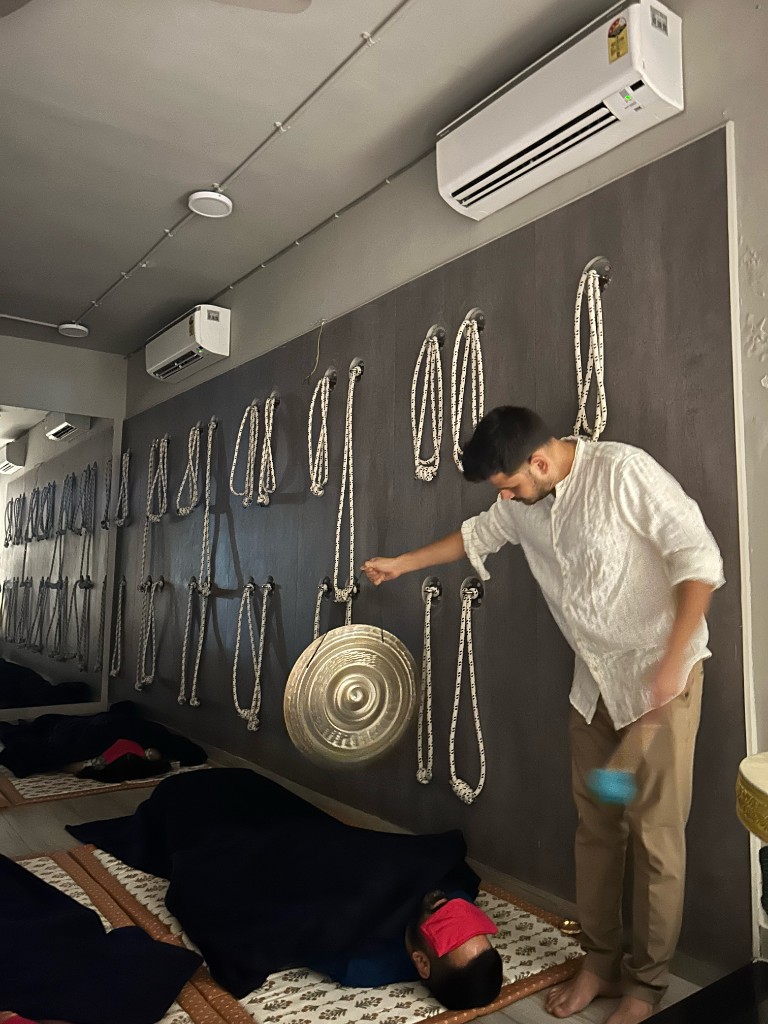
A sound bath is a session where you lie down, get comfortable, and are "bathed" in overlapping waves of sound. You are not asked to do anything — no chanting, no posture, no effort. A facilitator plays instruments in a slow, deliberate sequence while you rest and let attention follow the sound.
Sessions usually run 30–60 minutes. Most people spend them lying on a mat under a blanket, eyes closed.
How sound healing calms the nervous system
The mechanism is less mystical than it sounds. Slow, sustained, predictable sound gives your attention something simple and non-threatening to rest on. As attention settles, breathing tends to slow and lengthen, and the body shifts out of a "fight-or-flight" tilt toward the parasympathetic ("rest-and-digest") side of the nervous system.
Three things tend to happen:
- Attention narrows to the sound, interrupting rumination loops.
- Breathing slows, which nudges heart rate and physiology toward calm.
- The body registers safety — nothing is being demanded of it — and begins to down-regulate.
None of this requires belief. It is the same reason a slow exhale or a walk in quiet can settle you; sound simply makes the state easier to reach and hold.
What are the benefits?
People most commonly report:
- A drop in mental "noise" and overthinking
- Deep physical relaxation and easier sleep afterwards
- A reset feeling — like a short holiday for the mind
It is important to be honest about the evidence. Research on sound and relaxation is still early and small-scale. Sound healing is best understood as a relaxation and nervous-system practice, not a treatment for medical or psychiatric conditions. If you are managing a health condition, treat it as a complement to care, not a replacement.
Is it spiritual or scientific?
It can be either — or both. You can experience a sound bath as a purely physiological down-regulation tool, or as a contemplative practice. Neither is more "correct." At Avyukta Circle we teach it as a practical nervous-system reset first, and let the depth arrive on its own.
What to expect at your first session
If it is your first time, you may spend the first ten minutes wondering whether you are "doing it right." You are — there is nothing to do. For a full walk-through of the practical details, read what to expect at your first sound bath.
Getting started
Begin with a single guided session rather than trying to recreate it alone. A facilitator manages the pacing and the room so you can actually let go. If you are in Surat, our Sound Immersions run as a six-session reset designed to shift your baseline, not just give you one nice evening.
Related reading in this cluster: what to expect at your first sound bath.
Ready to feel this in practice, not just read about it?
See the Mind Reset